In Ecuador, according to the Ministry of Environment, Water and Ecological Transition, more than 105 thousand tons of glass bottles and containers, but only the 19% is recycled. The rest ends up in landfills, dumps, rivers or seas. Paradoxically, glass is a noble material that can be recycled infinite times, saves energy, prevents new extractions and reduces the carbon footprint.
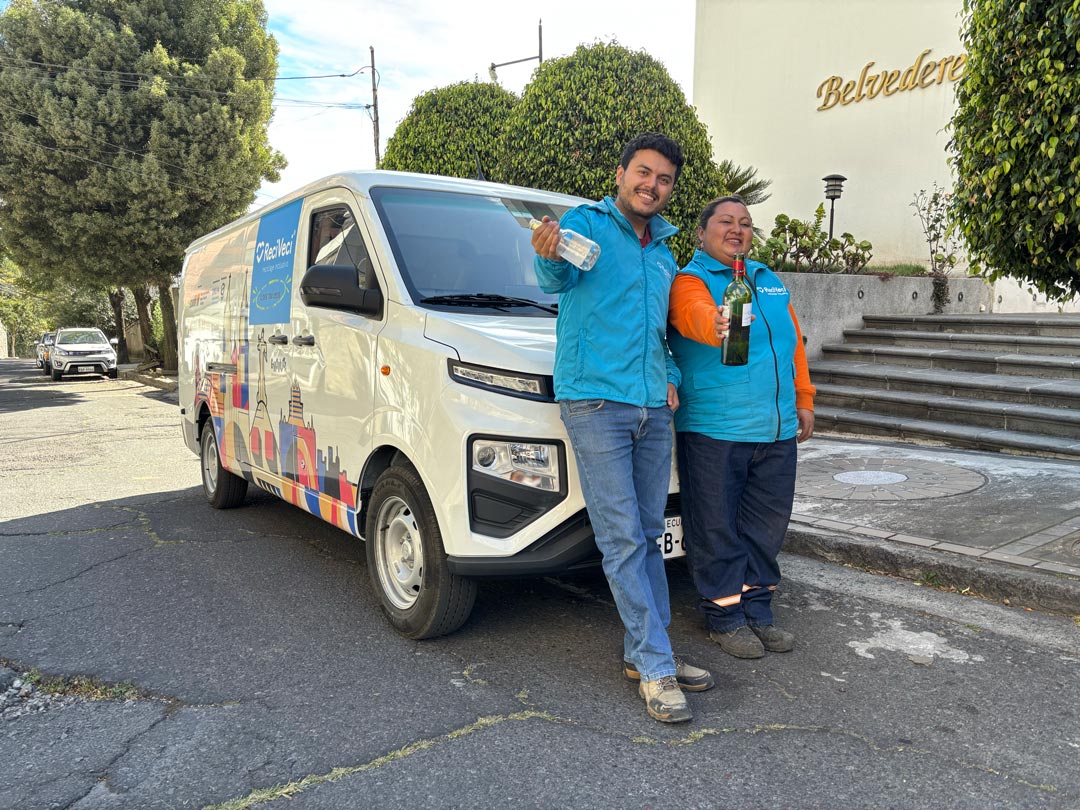
One of the biggest challenges in recycling glass has always been its transportation. It is a heavy, bulky and expensive material to move. As Pilar Caiza, a basic recycler, says, “we were losing when collecting glass because they paid very little and the trip was so long, and there was nowhere to store it. It often ended up in the trash because there was no safe place to receive it at a good price.” With the ReciveCi Glass Hub we are beginning to change this reality. Today we are taking a step further by testing recycling with zero carbon emissions, thanks to an electric van that travels through Quito collecting bottles and jars to return to the production chain. Betting on recycling not only means less waste, it is also a direct action against climate change.
The van is part of the project E-MOBILIZES, promoted by the Urban Electric Mobility (UEMI) initiative, in coordination with the United Nations Environment Program and the Ministry of Environment and Energy. This pilot seeks to demonstrate that electric mobility is feasible in Quito, a city where transportation is responsible for 70% of greenhouse gas emissions.
At ReciVeci we have received training for its use and we are testing it for several months. The van has the unique style of ReciVeci and if you see it in Quito remember that it not only collects glass, it also represents decent employment and inclusive recycling.
Thanks to its capacity, we can double the amount of glass collected on each route and reduce emissions to almost zero during collection. This means that more bottles will arrive at the Hub, where three women recyclers work as formal operators in decent conditions. Since the opening of the Hub, we have already recovered 1,500 tons of glass and we have more than 100 direct suppliers, 70 of them basic recyclers/ras who didn't work with this material before. For each of them, glass represents a additional income of approximately $50 per month, What increases in 30% of their monthly income.
With this pilot, we hope to further increase the amount of recovered glass and demonstrate that electric mobility and recycling can go together.
The recycling of glass with electric mobility is also a way of tackling climate change. Replacing a fossil-fuel vehicle with an electric van means stopping releasing CO₂ into the atmosphere, improving air quality in the city and demonstrating that clean transport can go hand in hand with the circular economy. Every bottle we recover with this technology translates into lower emissions, less waste and more innovation at the service of people and the planet.
If you have a bar, restaurant, cafeteria, hotel or business and you accumulate bottles, you can become a supplier of the Glass Hub. Write to us at +593 99 700 0926 and let's schedule the collection. And if you want to invest or promote projects together with the Hub, we also want to hear from you.
Because each recycled bottle means less pollution, more innovation and better living conditions for those who support recycling in our country.

