A lifetime of recycling
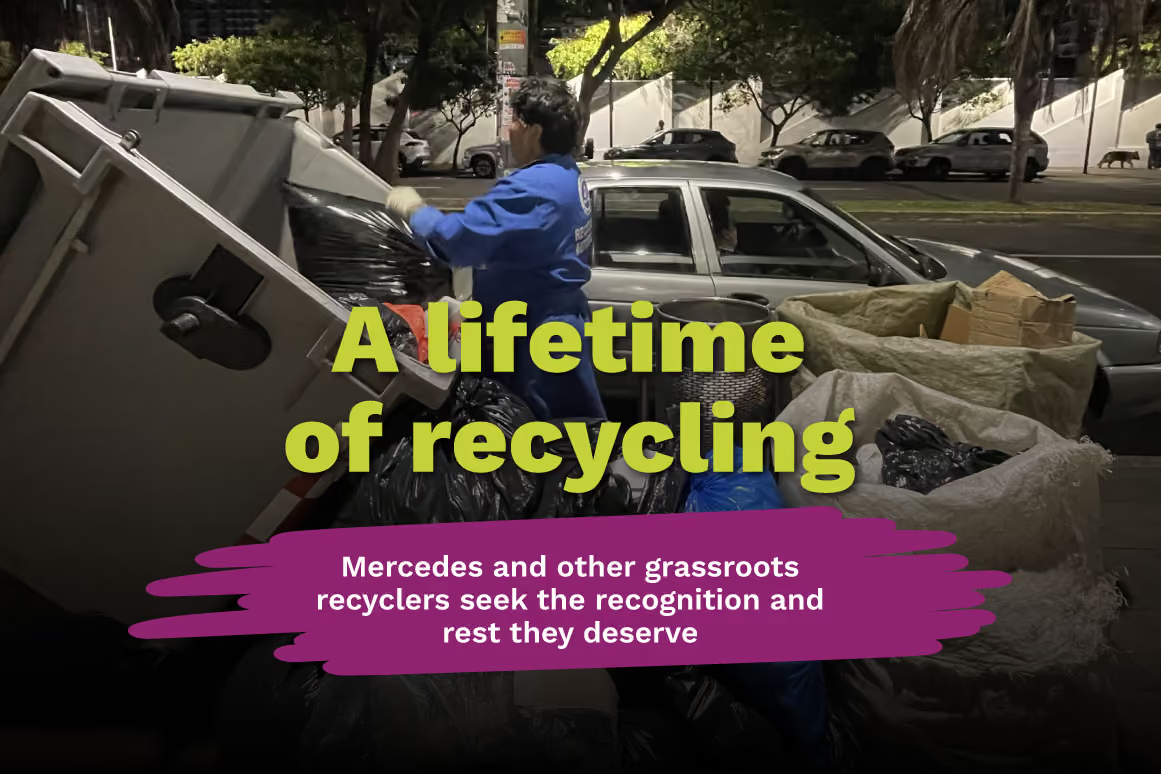
It's nighttime on Avenida República del Salvador, in the center-north of Quito. The glass buildings illuminate the street and the bars still have music at half volume. Between office workers hurrying and students chatting on street corners, a woman pushes a cart loaded with cardboard. Nobody looks at her twice.
Mercedes is over sixty years old and is still recycling. Your hands are burdened with three decades of quiet work. She belongs to a sector of the population that rarely appears in official statistics, although her work supports the entire country. As he walks the streets collecting cardboard, bottles and plastics, he thinks about what he would like to do if he could rest.
“At this age, I would like to go for a walk with my grandchildren, with my daughters, and I too can rest, no longer work, no longer recycle,” she says with a mixture of tiredness and hope.
Recycling was not a childhood dream or a vocational choice. It was, rather, one of the few options available to support his family. Mercedes proudly remembers that with what she wins “I have given the study to my daughters, it has been the basis of my household”. This phrase sums up the paradox: the most invisible work is also the one that has allowed hundreds of families to succeed.
The burden of age and lack of rest
Mercedes, with short hair, puts on her blue apron before leaving for work. Every day he faces the physical fatigue of walking long distances, negotiating low prices for collected material and returning home with just enough to cover the basics. Their income rarely exceeds $200 a month, less than half of the basic wage in Ecuador, which today stands at $470.
This is not an isolated case. According to the 2021 National Census of Waste Pickers, there are nearly 20,000 basic waste pickers in the country. Half of the adults who practice this profession are between 60 and 70 years old. The image of elderly people carrying cardboard packages or dragging wheelbarrows should shock an entire country, yet they often go unnoticed, as if they were part of the urban landscape.
A contribution that is not recognized
The numbers speak for themselves. According to the Ministry of Economic and Social Inclusion (MIES), grassroots recyclers collect approximately 50% of all recyclable material in Ecuador. Without them, much of what is reused today would end up in landfills and landfills. And they do so without machinery, without job stability, without health insurance and without access to a decent retirement. Only 4% are affiliated with the IESS.
The Ministry of Economic and Social Inclusion identified in the 2018 Social Register that a 61% of basic waste pickers are living in poverty, 45.7% in poverty and 18.8% in extreme poverty. Behind these percentages are stories like that of Mercedes, who since the early morning have been burdened with work that others prefer not to see.
A law with limited progress
In 2021, the Organic Law on Inclusive Circular Economy (LOECI) was approved. In theory, it opens a way to integrate the social dimension with recycling, promote ecodesign and guarantee decent and inclusive jobs. On paper, it seems like an enormous step forward, but in practice the changes have been slow.
For Mercedes, the law has not yet translated into real improvements. Conditions remain precarious and rest is still an impossible luxury. For this reason, those who defend the inclusion of waste pickers insist that a ton will only be fair if it meets five conditions:
- that the material arrives clean, dry and separated
- that payment be recognized for the collection service and not just for the sale of the material
- that there is formalization and legal support
- who have access to health and retirement
- that society values them as key actors in the circular economy
The value of partnerships
Faced with this reality, waste pickers' associations have found fairer ways to distribute effort and income. In several of them, the resources They are divided equally, which recognizes the time and work invested by older people who cannot collect the same things as young people, but do perform other essential tasks such as sorting into collection centers.
This model also has a human background, recognizes that one day everyone will age and that intergenerational solidarity is key to sustaining the recycling chain. In addition, the benefits are distributed among the associations that are part of the process and part is reserved to strengthen their operations, for example, acquiring more vehicles, installing their own collection centers and extending their services nationwide.
The Right to Retire
Mercedes' yearning is not extraordinary. He wants to rest, spend time with his grandchildren, enjoy life without daily distress. That desire should be a basic right, not an unattainable privilege.
Inclusive recycling not only involves recognizing those who make it possible, but also thinking about their future: ensuring that after decades of work, they can retire with dignity. Justice in recycling also means ensuring that those who have carried the city behind them have the opportunity to rest.
A break in the midst of routine
In the midst of so many deficiencies, there are also moments of respite. One of them was the ReciMañana Fun, organized by ReciVeci in 2025 to commemorate Waste Picker's Day. Thanks to the support of allies such as Latitude R and Fundación Avina, together with various companies and foundations, this event became a space for celebration, recognition and joy for those who support the recycling chain every day.
More than 220 waste pickers, their families and their children were able to access dental and visual care, clothing, haircuts and a space to rest and play. The children's laughter, the relief of a medical checkup and the chance to share in community demonstrated what dignity means. It doesn't solve everything, but it opens a window into what should be everyday and not exceptional.
What can we do?
At ReciVeci we work to ensure that recyclers like Mercedes receive clean and dry material, delivered by citizens or at our stations available at ReciApp. Thus, much of the material reaches them without the need to rummage through waste, which improves their income and gives them back time. As Mercedes says: “If they supported us, even recycling would be successful, they would call me, they would tell me, you know that Mrs. Mercedes, come and throw away the material and then I would have more time to take care of my mother, spend more time with her.”
The future of inclusive recycling depends on recognizing that waste pickers are not part of the landscape, but protagonists who deserve a decent life. We invite companies, institutions and citizens to join together so that initiatives such as the ReciMañana Fun are multiplied, and so that Mercedes, and thousands like her, they can age with the recognition and rest they deserve.


