Over 3,200 materials were recovered during the Ekos 2026 Sustainability Summit thanks to a recycling partnership.
Quito, April 2026.- During the Ekos 2026 Sustainability Summit, one of the country's most important gatherings on sustainability and innovation, a comprehensive recycling system was implemented, allowing for the recovery of 3,281 recyclable materials, equivalent to 278 kg, preventing these waste products from ending up in landfills.
The event brought together approximately 20,000 attendees over two days. In such venues, where food and beverage consumption is constant, large volumes of waste are generated, making it essential to have systems in place to ensure proper waste management.
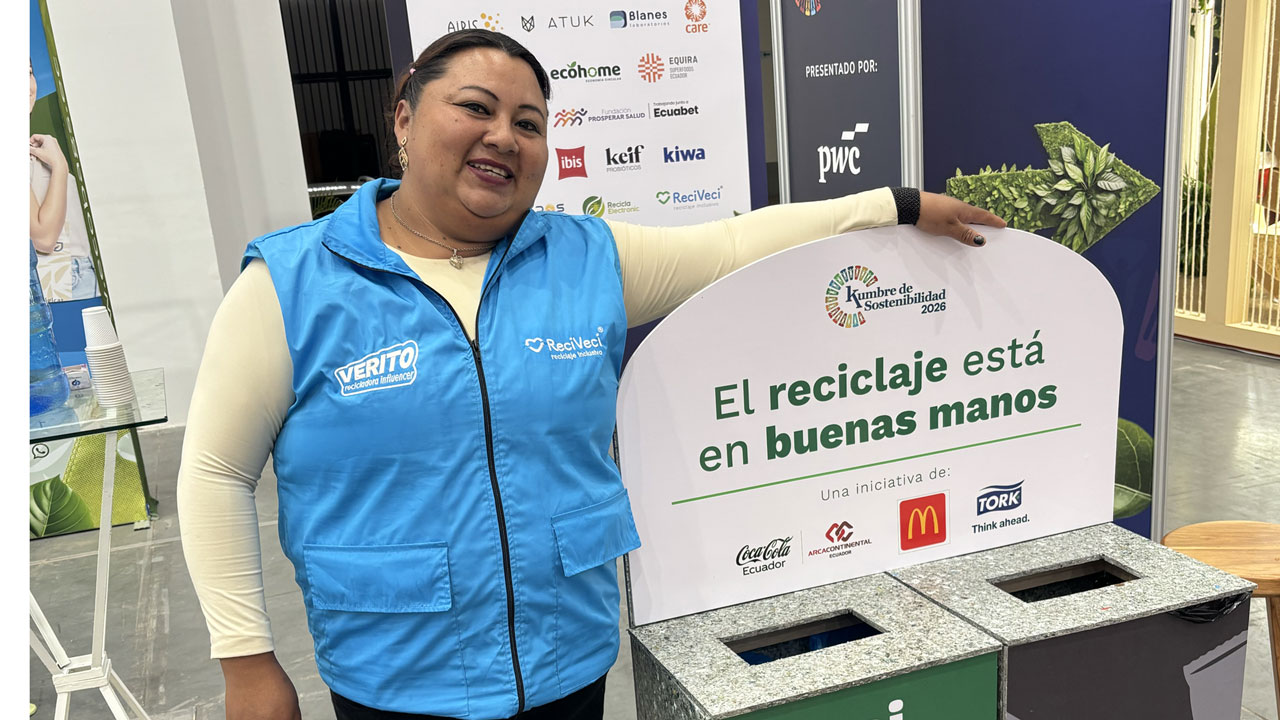
Under the concept "Recycling is in good hands," McDonald’s, Tork, Coca-Cola Ecuador, Arca Continental, and ReciVeci® coordinated a joint operation to manage the waste generated during the event in a technical, responsible, and socially impactful manner.
As part of this operation, eight recycling stations and eleven strategically located containers were installed throughout the venue. Additionally, a digital counter was implemented to record materials recovered in real-time during both days. As a result, a total of 3,281 units were recovered, equivalent to 278 kg of recyclable materials, preventing the emission of approximately 700 kg of CO₂ equivalent.
Among the recovered materials are 480 PET plastic bottles, collected through specialized containers located at various points throughout the event. Also noteworthy is the recovery of 42 kg of polyboard, a material that will be reincorporated into transformation processes to become new paper napkins, as part of a circular economy initiative.
Recycling with Social Impact
In Ecuador, more than 20,000 informal waste pickers sustain recycling day in and day out, generating an environmental and economic impact for thousands of families.
During the Kumbre, on-site operations were led by the Asociación Por un Futuro Mejor. Ten people, including informal waste pickers and environmental promoters, were in charge of material recovery and guiding attendees on proper waste separation, strengthening the recycling culture within the event.
“Behind every recovered material, there is a system at work and people who make it possible. Our work at ReciVeci® is to design solutions that enable companies to manage their waste responsibly, integrating informal waste pickers as key players within the circular economy,” said Lorena Gallardo, Innovation and Sustainability Manager at ReciVeci®
Why this matters
In Ecuador, up to 14,200 tons of waste are generated daily, and barely 5% is recycled. This context highlights the need to implement concrete solutions that allow for material recovery and reduce pressure on landfills.
The Kumbre experience demonstrates that mass events can become spaces to drive the circular economy, recover resources, and promote a culture of shared responsibility in waste management.
The reported data corresponds to waste managed during the event days, not including the setup and dismantling phases.

